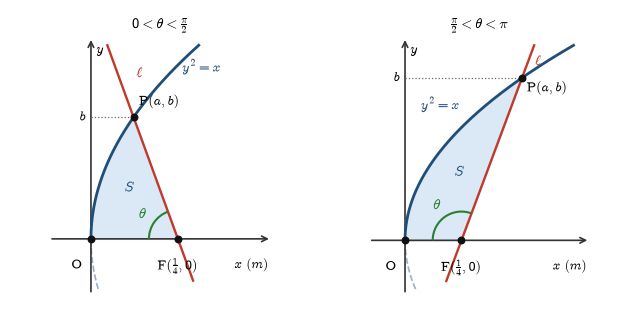
(1) 点 P ( a , b ) \mathrm{P}(a,b) P ( a , b ) y 2 = x y^2=x y 2 = x b > 0 b>0 b > 0 a = b 2 a=b^2 a = b 2
まず、b b b θ \theta θ O ( 0 , 0 ) \mathrm{O}(0,0) O ( 0 , 0 ) F ( 1 4 , 0 ) \mathrm{F}\left(\dfrac{1}{4},0\right) F ( 4 1 , 0 ) P ( b 2 , b ) \mathrm{P}(b^2,b) P ( b 2 , b )
F O → = ( − 1 4 , 0 ) , F P → = ( b 2 − 1 4 , b ) \overrightarrow{\mathrm{FO}}=\left(-\frac{1}{4},0\right),\quad
\overrightarrow{\mathrm{FP}}=\left(b^2-\frac{1}{4},b\right) FO = ( − 4 1 , 0 ) , FP = ( b 2 − 4 1 , b ) である。∣ F O → ∣ = 1 4 \left\lvert\overrightarrow{\mathrm{FO}}\right\rvert=\dfrac{1}{4} FO = 4 1 b 2 + 1 4 > 0 b^2+\dfrac{1}{4}>0 b 2 + 4 1 > 0
∣ F P → ∣ = ( b 2 − 1 4 ) 2 + b 2 = ( b 2 + 1 4 ) 2 = b 2 + 1 4 \begin{aligned}
\left\lvert\overrightarrow{\mathrm{FP}}\right\rvert
&= \sqrt{\left(b^2-\frac{1}{4}\right)^2+b^2} \\
&= \sqrt{\left(b^2+\frac{1}{4}\right)^2} \\
&= b^2+\frac{1}{4}
\end{aligned} FP = ( b 2 − 4 1 ) 2 + b 2 = ( b 2 + 4 1 ) 2 = b 2 + 4 1 である。θ = ∠ P F O \theta=\angle\mathrm{PFO} θ = ∠ PFO
cos θ = F O → ⋅ F P → ∣ F O → ∣ ∣ F P → ∣ = − 1 4 ( b 2 − 1 4 ) 1 4 ( b 2 + 1 4 ) = 1 − 4 b 2 1 + 4 b 2 \begin{aligned}
\cos\theta
&= \frac{\overrightarrow{\mathrm{FO}}\cdot\overrightarrow{\mathrm{FP}}}{\left\lvert\overrightarrow{\mathrm{FO}}\right\rvert\left\lvert\overrightarrow{\mathrm{FP}}\right\rvert} \\
&= \frac{-\dfrac{1}{4}\left(b^2-\dfrac{1}{4}\right)}{\dfrac{1}{4}\left(b^2+\dfrac{1}{4}\right)} \\
&= \frac{1-4b^2}{1+4b^2}
\end{aligned} cos θ = FO FP FO ⋅ FP = 4 1 ( b 2 + 4 1 ) − 4 1 ( b 2 − 4 1 ) = 1 + 4 b 2 1 − 4 b 2 が成り立つ。
補足 角の基準となる向きと焦点の性質 原点 O ( 0 , 0 ) \mathrm{O}(0,0) O ( 0 , 0 ) F ( 1 4 , 0 ) \mathrm{F}\left(\dfrac{1}{4},0\right) F ( 4 1 , 0 ) F O → \overrightarrow{\mathrm{FO}} FO x x x x x x y 2 = x y^2=x y 2 = x x = − 1 4 x=-\dfrac{1}{4} x = − 4 1 F P = b 2 − ( − 1 4 ) = b 2 + 1 4 \mathrm{FP}=b^2-\left(-\dfrac{1}{4}\right)=b^2+\dfrac{1}{4} FP = b 2 − ( − 4 1 ) = b 2 + 4 1
分母を払って b 2 b^2 b 2
4 b 2 ( 1 + cos θ ) = 1 − cos θ 4b^2(1+\cos\theta)=1-\cos\theta 4 b 2 ( 1 + cos θ ) = 1 − cos θ となる。1 + cos θ = 2 cos 2 θ 2 1+\cos\theta=2\cos^2\dfrac{\theta}{2} 1 + cos θ = 2 cos 2 2 θ 1 − cos θ = 2 sin 2 θ 2 1-\cos\theta=2\sin^2\dfrac{\theta}{2} 1 − cos θ = 2 sin 2 2 θ
8 b 2 cos 2 θ 2 = 2 sin 2 θ 2 8b^2\cos^2\frac{\theta}{2}=2\sin^2\frac{\theta}{2} 8 b 2 cos 2 2 θ = 2 sin 2 2 θ を得る。0 < θ < π 0<\theta<\pi 0 < θ < π 0 < θ 2 < π 2 0<\dfrac{\theta}{2}<\dfrac{\pi}{2} 0 < 2 θ < 2 π cos θ 2 > 0 \cos\dfrac{\theta}{2}>0 cos 2 θ > 0 tan θ 2 > 0 \tan\dfrac{\theta}{2}>0 tan 2 θ > 0 b > 0 b>0 b > 0
b = 1 2 tan θ 2 b=\frac{1}{2}\tan\frac{\theta}{2} b = 2 1 tan 2 θ となる。
次に、面積 S S S m m m y = 0 y=0 y = 0 F ( 1 4 , 0 ) \mathrm{F}\left(\dfrac{1}{4},0\right) F ( 4 1 , 0 ) P ( b 2 , b ) \mathrm{P}(b^2,b) P ( b 2 , b ) ℓ \ell ℓ x x x
x = 1 4 + b 2 − 1 4 b y x=\frac{1}{4}+\frac{b^2-\dfrac{1}{4}}{b}y x = 4 1 + b b 2 − 4 1 y である。x = y 2 x=y^2 x = y 2 x x x
( 1 4 + b 2 − 1 4 b y ) − y 2 = − y 2 + ( b − 1 4 b ) y + 1 4 = ( b − y ) ( y + 1 4 b ) \begin{aligned}
&\left(\frac{1}{4}+\frac{b^2-\dfrac{1}{4}}{b}y\right)-y^2 \\
&= -y^2+\left(b-\frac{1}{4b}\right)y+\frac{1}{4} \\
&= (b-y)\left(y+\frac{1}{4b}\right)
\end{aligned} 4 1 + b b 2 − 4 1 y − y 2 = − y 2 + ( b − 4 b 1 ) y + 4 1 = ( b − y ) ( y + 4 b 1 ) となる。b > 0 b>0 b > 0 0 ≦ y ≦ b 0\leqq y\leqq b 0 ≦ y ≦ b ( b − y ) ( y + 1 4 b ) ≧ 0 (b-y)\left(y+\dfrac{1}{4b}\right)\geqq 0 ( b − y ) ( y + 4 b 1 ) ≧ 0 y = 0 y=0 y = 0 O ( 0 , 0 ) \mathrm{O}(0,0) O ( 0 , 0 ) ℓ \ell ℓ F ( 1 4 , 0 ) \mathrm{F}\left(\dfrac{1}{4},0\right) F ( 4 1 , 0 ) y ≧ 0 y\geqq 0 y ≧ 0 ℓ \ell ℓ P ( b 2 , b ) \mathrm{P}(b^2,b) P ( b 2 , b )
よって、求める面積 S S S y y y
S = ∫ 0 b { 1 4 + ( b − 1 4 b ) y − y 2 } d y = [ 1 4 y + 1 2 ( b − 1 4 b ) y 2 − 1 3 y 3 ] 0 b = 1 4 b + 1 2 b 3 − 1 8 b − 1 3 b 3 = 1 6 b 3 + 1 8 b \begin{aligned}
S
&= \int_0^b \left\{\frac{1}{4}+\left(b-\frac{1}{4b}\right)y-y^2\right\}dy \\
&= \left[\frac{1}{4}y+\frac{1}{2}\left(b-\frac{1}{4b}\right)y^2-\frac{1}{3}y^3\right]_0^b \\
&= \frac{1}{4}b+\frac{1}{2}b^3-\frac{1}{8}b-\frac{1}{3}b^3 \\
&= \frac{1}{6}b^3+\frac{1}{8}b
\end{aligned} S = ∫ 0 b { 4 1 + ( b − 4 b 1 ) y − y 2 } d y = [ 4 1 y + 2 1 ( b − 4 b 1 ) y 2 − 3 1 y 3 ] 0 b = 4 1 b + 2 1 b 3 − 8 1 b − 3 1 b 3 = 6 1 b 3 + 8 1 b となる。
補足 特殊な角での面積の検算 θ = π 2 \theta=\dfrac{\pi}{2} θ = 2 π P \mathrm{P} P F \mathrm{F} F ( 1 4 , 1 2 ) \left(\dfrac{1}{4},\dfrac{1}{2}\right) ( 4 1 , 2 1 ) x x x ∫ 0 1 4 x d x = [ 2 3 x 3 2 ] 0 1 4 = 1 12 \displaystyle\int_0^{\frac{1}{4}}\sqrt{x}\,dx=\left[\frac{2}{3}x^{\frac{3}{2}}\right]_0^{\frac{1}{4}}=\frac{1}{12} ∫ 0 4 1 x d x = [ 3 2 x 2 3 ] 0 4 1 = 12 1 b = 1 2 b=\dfrac{1}{2} b = 2 1 1 6 ⋅ 1 8 + 1 8 ⋅ 1 2 = 1 12 \dfrac{1}{6}\cdot\dfrac{1}{8}+\dfrac{1}{8}\cdot\dfrac{1}{2}=\dfrac{1}{12} 6 1 ⋅ 8 1 + 8 1 ⋅ 2 1 = 12 1
これに b = 1 2 tan θ 2 b=\dfrac{1}{2}\tan\dfrac{\theta}{2} b = 2 1 tan 2 θ
S = 1 48 tan 3 θ 2 + 1 16 tan θ 2 S=\frac{1}{48}\tan^3\frac{\theta}{2}+\frac{1}{16}\tan\frac{\theta}{2} S = 48 1 tan 3 2 θ + 16 1 tan 2 θ であるから、0 < θ < π 0<\theta<\pi 0 < θ < π
S θ = tan θ 2 θ ( 1 48 tan 2 θ 2 + 1 16 ) \frac{S}{\theta}=\frac{\tan\dfrac{\theta}{2}}{\theta}\left(\frac{1}{48}\tan^2\frac{\theta}{2}+\frac{1}{16}\right) θ S = θ tan 2 θ ( 48 1 tan 2 2 θ + 16 1 ) と表せる。
lim θ → + 0 tan θ 2 θ = lim θ → + 0 1 2 ⋅ sin θ 2 θ 2 ⋅ 1 cos θ 2 = 1 2 ⋅ 1 ⋅ 1 = 1 2 \begin{aligned}
\lim_{\theta\to+0}\frac{\tan\dfrac{\theta}{2}}{\theta}
&= \lim_{\theta\to+0}\frac{1}{2}\cdot\frac{\sin\dfrac{\theta}{2}}{\dfrac{\theta}{2}}\cdot\frac{1}{\cos\dfrac{\theta}{2}} \\
&= \frac{1}{2}\cdot 1\cdot 1=\frac{1}{2}
\end{aligned} θ → + 0 lim θ tan 2 θ = θ → + 0 lim 2 1 ⋅ 2 θ sin 2 θ ⋅ cos 2 θ 1 = 2 1 ⋅ 1 ⋅ 1 = 2 1 であり、また lim θ → + 0 tan θ 2 = 0 \displaystyle\lim_{\theta\to+0}\tan\dfrac{\theta}{2}=0 θ → + 0 lim tan 2 θ = 0
lim θ → + 0 S θ = 1 2 ( 0 + 1 16 ) = 1 32 \lim_{\theta\to+0}\frac{S}{\theta}=\frac{1}{2}\left(0+\frac{1}{16}\right)=\frac{1}{32} θ → + 0 lim θ S = 2 1 ( 0 + 16 1 ) = 32 1 である。
答:1 32 \dfrac{1}{32} 32 1
補足 直角三角形による極限値の検算 θ → + 0 \theta\to+0 θ → + 0 P \mathrm{P} P O \mathrm{O} O x = y 2 x=y^2 x = y 2 y y y m m m O F = 1 4 \mathrm{OF}=\dfrac{1}{4} OF = 4 1 1 4 tan θ \dfrac{1}{4}\tan\theta 4 1 tan θ 1 2 ⋅ 1 4 ⋅ 1 4 θ = 1 32 θ \dfrac{1}{2}\cdot\dfrac{1}{4}\cdot\dfrac{1}{4}\theta=\dfrac{1}{32}\theta 2 1 ⋅ 4 1 ⋅ 4 1 θ = 32 1 θ 1 32 \dfrac{1}{32} 32 1
(2) φ = π − θ \varphi=\pi-\theta φ = π − θ θ → π − 0 \theta\to\pi-0 θ → π − 0 φ → + 0 \varphi\to+0 φ → + 0 0 < φ < π 0<\varphi<\pi 0 < φ < π θ 2 = π 2 − φ 2 \dfrac{\theta}{2}=\dfrac{\pi}{2}-\dfrac{\varphi}{2} 2 θ = 2 π − 2 φ
tan θ 2 = tan ( π 2 − φ 2 ) = 1 tan φ 2 \tan\frac{\theta}{2}=\tan\left(\frac{\pi}{2}-\frac{\varphi}{2}\right)=\frac{1}{\tan\dfrac{\varphi}{2}} tan 2 θ = tan ( 2 π − 2 φ ) = tan 2 φ 1 となる。S S S
( π − θ ) 3 S = φ 3 ( 1 48 tan 3 φ 2 + 1 16 tan φ 2 ) = 1 48 ( φ tan φ 2 ) 3 + 1 16 φ 2 ( φ tan φ 2 ) \begin{aligned}
&(\pi-\theta)^3S\\
&= \varphi^3\left(\frac{1}{48\tan^3\dfrac{\varphi}{2}}+\frac{1}{16\tan\dfrac{\varphi}{2}}\right) \\
&= \frac{1}{48}\left(\frac{\varphi}{\tan\dfrac{\varphi}{2}}\right)^3\\
&\qquad+\frac{1}{16}\varphi^2\left(\frac{\varphi}{\tan\dfrac{\varphi}{2}}\right)
\end{aligned} ( π − θ ) 3 S = φ 3 48 tan 3 2 φ 1 + 16 tan 2 φ 1 = 48 1 tan 2 φ φ 3 + 16 1 φ 2 tan 2 φ φ と変形できる。
lim φ → + 0 φ tan φ 2 = lim φ → + 0 2 ⋅ φ 2 sin φ 2 ⋅ cos φ 2 = 2 ⋅ 1 ⋅ 1 = 2 \begin{aligned}
\lim_{\varphi\to+0}\frac{\varphi}{\tan\dfrac{\varphi}{2}}
&= \lim_{\varphi\to+0}2\cdot\frac{\dfrac{\varphi}{2}}{\sin\dfrac{\varphi}{2}}\cdot\cos\frac{\varphi}{2} \\
&= 2\cdot 1\cdot 1=2
\end{aligned} φ → + 0 lim tan 2 φ φ = φ → + 0 lim 2 ⋅ sin 2 φ 2 φ ⋅ cos 2 φ = 2 ⋅ 1 ⋅ 1 = 2 であり、また lim φ → + 0 φ 2 = 0 \displaystyle\lim_{\varphi\to+0}\varphi^2=0 φ → + 0 lim φ 2 = 0
lim θ → π − 0 ( π − θ ) 3 S = 1 48 ⋅ 2 3 + 1 16 ⋅ 0 ⋅ 2 = 1 6 \begin{aligned}
\lim_{\theta\to\pi-0}(\pi-\theta)^3S
&= \frac{1}{48}\cdot 2^3+\frac{1}{16}\cdot 0\cdot 2 \\
&= \frac{1}{6}
\end{aligned} θ → π − 0 lim ( π − θ ) 3 S = 48 1 ⋅ 2 3 + 16 1 ⋅ 0 ⋅ 2 = 6 1 である。
答:1 6 \dfrac{1}{6} 6 1
補足 1/6公式から見る極限値の意味 放物線 x = y 2 x=y^2 x = y 2 ℓ \ell ℓ y y y − 1 4 b -\dfrac{1}{4b} − 4 b 1 θ → π − 0 \theta\to\pi-0 θ → π − 0 φ → + 0 \varphi\to+0 φ → + 0 b ≈ 1 φ → + ∞ b\approx\dfrac{1}{\varphi}\to+\infty b ≈ φ 1 → + ∞ y < 0 y<0 y < 0 0 0 0 S S S ℓ \ell ℓ 1 6 { b − ( − 1 4 b ) } 3 ≈ 1 6 b 3 ≈ 1 6 φ 3 \dfrac{1}{6}\left\{b-\left(-\dfrac{1}{4b}\right)\right\}^3\approx\dfrac{1}{6}b^3\approx\dfrac{1}{6\varphi^3} 6 1 { b − ( − 4 b 1 ) } 3 ≈ 6 1 b 3 ≈ 6 φ 3 1 1 6 \dfrac{1}{6} 6 1

 LINEで相談!

問題データ